

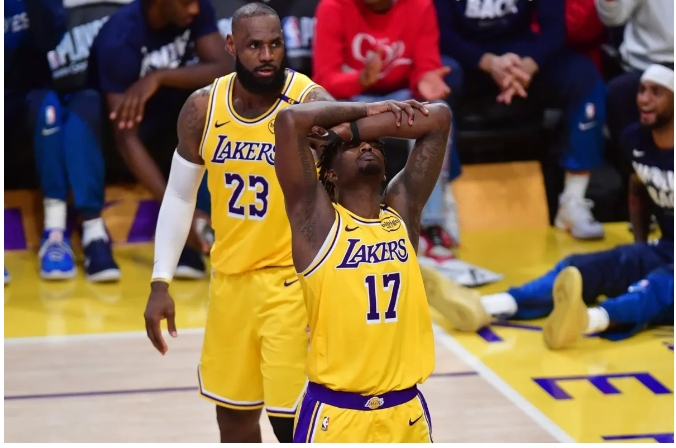
Luka Dončić walked off the court after a season-ending loss, facing tough questions and a long summer. Mavericks fans, no doubt, kept an eye on the Los Angeles Lakers’ postseason run, however brief it was. Their first-round exit only accelerates the already challenging task of building a championship contender around Dončić. But that’s the Lakers’ problem. For Mavs fans, the question is what can be learned from that series to better understand Dallas’ approach to team-building—and how might that shape a pivotal offseason
Defense wins championships.” Nico Harrison has made it clear that this is the primary tenet of his philosophy. Over the past 40 years, only four NBA champions have finished outside the top 10 in defensive rating. Playoff basketball is fundamentally different from the regular season. Weaknesses are identified, targeted, and exploited. You can’t afford to have multiple defensive liabilities on the floor. Case in point, the Timberwolves relentlessly attacked both Dončić and Austin Reaves. One defensive weak spot can be managed; any more than that, and your team starts to crack.
Today’s NBA offenses are already maximized—there may not be much more room for growth on that end. While innovative cutting actions may represent a new kind of spacing, the offensive formula is largely set: space, pace, threes, and layups. For the first time ever, more than 90 percent of all shots taken during the regular season were three-pointers or in the paint. So the new frontier for competitive advantage? Defense, both in scheme and talent. That’s why the Mavericks are focusing where they are.
The focus on defense means you can’t afford to have one-dimensional players. Versatility is another core principle. That includes having two-way players who can stay on the floor regardless of the situation. Just as you can’t survive with multiple defensive liabilities, you also can’t afford to play two non-shooters together. Teams will collapse the floor against any lineup featuring more than one player who can’t stretch the defense. That spacing issue became glaring in the NBA Finals last year and was a driving force behind the Mavs’ signing of Klay Thompson.
Versatility also extends to defensive schemes. The Mavs want players who can switch 1 through 5 and adapt to various playing styles. That means being able to toggle between lineups with two bigs, one big, and even—when necessary—none at all, as both the Mavs and Lakers had to do at times this season.
And without the depth to withstand injuries, you won’t even make it to the playoffs, a fact the Mavericks know all too well. Injuries devastated Dallas this year. According to the invaluable Jeff Stotts, the Mavs lost 336 games to injury—sixth most in the league (No. 1 when accounting for quality of player). It was Dallas’ highest total since the NBA began tracking such data in 2005-06. It wasn’t just a Mavs problem, either; by some measures, this may have been the most injury-riddled season league-wide in two decades.
But depth isn’t valuable for just the regular season—it matters in the playoffs, too. Yes, rotations shrink in the postseason, but no team took that as far as the Lakers. In Game 4, they played the same five players for the entire second half, an NBA playoff first. Coach J.J. Redick clearly felt he had no other viable options. And in the fourth quarter of the elimination game that followed, Redick was so searching for answers that he turned to Maxi Kleber in an attempt to draw Gobert away from the basket. Never mind that Kleber hadn’t played since his January acquisition. The wisdom of these decisions is up for debate, but the lack of depth was obvious.
Harrison has acknowledged that the Mavs’ championship window is three to four seasons. Their chips are already in the middle of the table. So should they go all-in this summer by trading for another star, even if it costs even more future assets? There’s certainly a case to be made for that. But if depth is truly a priority, as the front office maintains, that approach may contradict the stated goals.
Rudy Gobert’s dominant Game 5 performance exposed the Lakers’ fundamental flaw: a lack of size. Bigs are back, as the Mavs are well aware. The top teams in the league aren’t just playing with size—they’re doubling down on it. Boston plays significant chunks of time with Kristaps Porziņģis and Al Horford on the floor. Cleveland starts Evan Mobley and Jarrett Allen. Oklahoma City features Isaiah Hartenstein and Chet Holmgren. Houston rolls with Alperen Şengün and Steven Adams. Dallas, meanwhile, uses Anthony Davis alongside Dereck Lively II or Daniel Gafford. In today’s NBA, size is not optional—it’s essential.
Big lineups offer advantages on both ends. Defensively, they provide vital rim protection in a league where layups are a priority and so many shots are coming from in the paint. Teams try to force the big out to the perimeter in pick-and-roll actions, then blow past him with no one left to contest at the rim. With two bigs, someone is always on the back line for help.
Offensively, the high-low game becomes viable. One big can catch at the elbow, drawing the center out, while the other exploits a mismatch at the rim. This dynamic explains why Davis stretching his range is still paramount when it comes to spacing.
Fouls and free throw attempts hit historic lows during the regular season, and we all know they’re even harder to come by in the playoffs. Just ask the Detroit Pistons. In the Rockets-Warriors series, outcomes were often dictated by which team set the tone physically. Against the Lakers, Anthony Edwards used his physicality to send a message. That’s the mentality the Mavs are now prioritizing—players who play with force and physicality.
The Lakers’ early exit leaves their franchise at a crossroads. But it also provides Mavericks fans an invaluable lens for understanding their own team’s direction. As Dallas approaches a crucial summer of roster building, its foundational pillars are clearer than ever: defense, versatility, depth, size, and physicality. These aren’t just buzzwords—they’re the roadmap. A summer like no other awaits. And for Mavs fans searching for a reason to believe again, maybe this could be the beginning.
